
Documentation / Operating model
Ecosystem anatomy
Distinguish business domains, groupings, products and execution.
Purpose
Hives and beekeeping give us a language for cooperation, local responsibility and care for the whole. It is an organisational metaphor: people, decision rights and data products remain explicit.
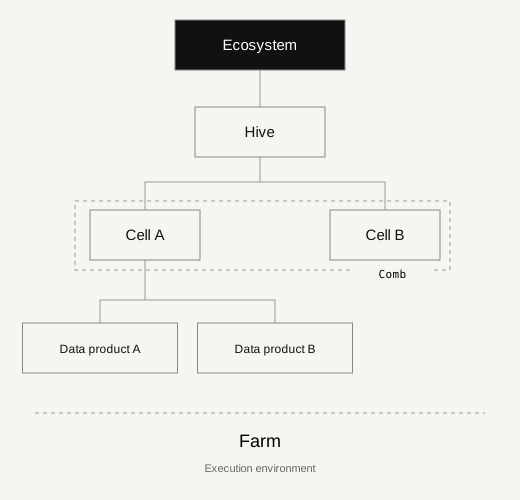
Ecosystem / Shared purpose
The boundary of collaboration: objectives, participating domains, common policies and accountable governance. Start with a use case and a named sponsor.
Typical evidence: Policy, decision log, value indicator.
Hive / Business domain
A domain with an accountable owner, its own meaning and priorities. It coordinates its Cells while respecting the ecosystem’s minimum rules.
Typical evidence: Domain charter, owner, glossary.
Cell / Business subdomain
A focused subdomain inside a Hive. Stewardship and engineering work close to the data. A Cell can own several data products; the Cell is not itself a product.
Typical evidence: Steward, quality rules, product inventory.
Comb / Business grouping
An optional grouping of Cells within the same Hive. A Cell may belong to several Combs. This is a business and permission grouping, not an extra infrastructure layer.
Typical evidence: Grouping criteria, scoped responsibilities.
Data product / An accountable offering
A purposeful offering with a named owner, versioned contract, known consumers, quality expectations and a lifecycle. Tables, APIs and dashboards can be delivery interfaces.
Typical evidence: Contract, tests, access record, usage.
Farm / Execution environment
Where products are cultivated and operated: production, test or development environments. The Farm is an execution boundary, distinct from business ownership.
Typical evidence: Inventory, access controls, recovery evidence.
Scope and limitations
The metaphor helps explain the model. It does not replace an organisation’s terminology or assign human roles based on bee biology.
Continue reading
Original KDV Framework knowledge. Working community edition 0.1. CC BY 4.0. References retain their owners’ rights; no official assessment or certification is implied.